Electronic Bill of Rights is Free Information for The Public

Electronic Bill of Rights is Free Information for The Public
The Electronic Bill of Rights (EBOR) restores sovereignty over your Name, Image, Likeness, and Data (NILD)—your identity, your data, your property, and your rights.
“Just because you entrust your data—in some cases, your modern-day papers and effects—to a third party may not mean you lose any Fourth Amendment interest in its contents.”- Justice Neil Gorsuch, Carpenter v. United States, 585 U.S. 296 (2018)
In today's connected world people own phones, computers, and products supported by Android, iOS, and Windows operating systems which in turn support highly addictive and intrusive AI infused apps and platforms designed to enable the developer to conduct audio, video, and physical surveillance on the product owner and end user, including children and business professionals for profit.
The addictive AI infused apps and platforms also enable the developers to collect highly confidential personal and business information in the form of one's Name, Image, Likeness, and Data (NILD) to exploit for profits without compensating the individual who produced the NILD from the products that they own.
In the end, the individual owns the products, creates the NILD, and has rights and laws that protect their privacy, private property, and safety.
“The fact that the information is held by a third party does not by itself overcome the user’s claim to Fourth Amendment protection.”— Chief Justice John Roberts, Carpenter v. United States (2018)
Today operating system developers, AI, app, and platform developers are circumventing numerous laws to collect your NILD, plus the NILD of your children, to exploit for profits while the U.S. government is simply not enforcing existing constitutional protections, plus numerous consumer protection, child protection, and privacy laws due to the powerful U.S. China Tech Lobby.
The circumvention of these constitutional protections, plus privacy and consumer protection laws have created a need for digital rights based on the enforcement of existing laws and constitutional protections through an Electronic Bill of Rights.
Constitutional Foundation for Digital Property Rights- Your Products, Your Data, Your Rights!
The Electronic Bill of Rights is built upon the constitutional principles embodied in the Fourth, Fifth, and Fourteenth Amendments of the United States Constitution, recognizing that these protections should extend to the digital age.
Privacy, property, and liberty should not end where the digital world begins.
“It seems to me entirely possible a person’s cell-site data could qualify as his papers or effects under existing law.” - Justice Neil Gorsuch, Carpenter v. United States, 585 U.S. 296 (2018)
The constitutional principles that have protected Americans for more than two centuries should extend equally to an individual's Name, Image, Likeness, and Data in the digital age.
EBOR digital rights framework is also centered on enforcement of existing consumer protection, child protection, and Federal Communication Commission privacy laws associated with phones, computers, and products supported by telecommunication and internet infrastructure regulated by the federal government.
EBOR recognizes that the constitutional principles protecting privacy, property, civil liberties, and human rights should extend to the digital age.
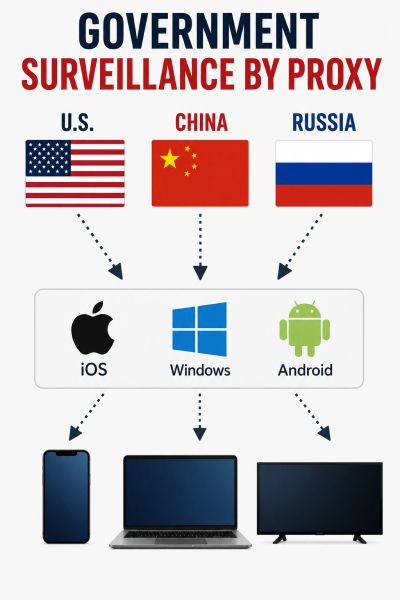
EBOR prevents the constitutional protections embodied in the Fourth, Fifth, and Fourteenth Amendments from being circumvented by proxy through digital technologies and legal mechanisms, including consumer contracts of adhesion (Terms of Service) that compel participation in surveillance and data-mining business models.
These illegal predatory consumer agreements require the owners of phones, computers, and connected products to surrender their rights to privacy, property, security, safety, data sovereignty, biological sovereignty, financial sovereignty, civil liberties, and human rights as a condition of using the very products and services they have purchased.
These predatory agreements enable multinational corporations—including those based in adversarial nations—to surveil your daily life while monetizing the Name, Image, Likeness, and Data (NILD) collected through your privately owned products and devices.
As connected products have become the gateway to modern life, an individual’s Name, Image, Likeness, and Data (NILD) have become the digital equivalent of a person’s “papers and effects”—protected by the Constitution against unreasonable searches and seizures as a fundamental safeguard of privacy.
This is true for children.
Over the last 20 years, the tech and advertising industries have waged a campaign to desensitize the public to the loss of privacy, civil liberties, and constitutional protections associated with the search and seizure of an individual’s Name, Image, Likeness, and Data (NILD)—the digital equivalent of a person’s “papers and effects.”
NILD encompasses highly sensitive information generated, stored, or accessible through connected products, including:
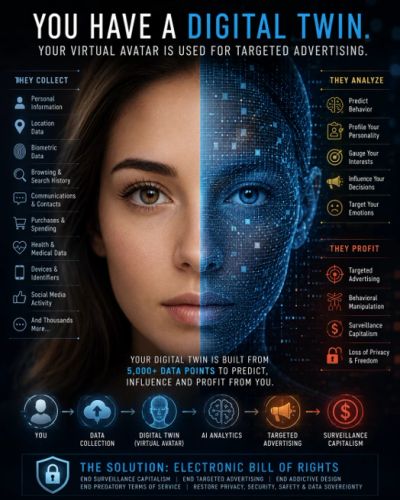
All of this information is aggregated by the developers who collect it to create an identifiable digital profile that advertisers call your “Digital Twin.” Your children also have Digital Twins, which are exploited for profit through targeted advertising and data broker sales.
Your NILD may also be shared, directly or indirectly, with governments and military contractors around the world—posing significant privacy, security, and safety threats to you, your family, and your business.
This is also true for businesses that use phones, computers, and other products supported by Android, iOS, or Windows—their business information creates a Digital Twin as well.
For some businesses, this information can end up in the hands of adversarial nations and business competitors, posing significant cybersecurity, privacy, security, and economic threats to the business.
All of this information makes up your NILD—and the NILD of your children.
In the digital age, the constitutional principle remains the same: your private information should not lose its protection simply because your “papers and effects” have become digital.
The tech industry and numerous governments have waged a 20 plus year campaign to desensitize society—including businesses—to the idea that it is acceptable for multinational corporations, military contractors, and governments, directly or by proxy, to monitor, track, and data-mine citizens, children, and business professionals for profit 24 hours a day, 365 days a year through the very products and services they own and use.
This continuous surveillance and data mining creates an individual’s or business’s Name, Image, Likeness, and Data (NILD), or “Digital Twin,” which is then exploited for profit through highly addictive, harmful, and deadly AI-infused apps, platforms, and digital services used by adults, teens, and children.
As a result, society has increasingly accepted the premise that there is no expectation of privacy or security when using a phone, computer, or connected product supported by telecommunications and internet infrastructure regulated by the Federal Communications Commission forgoing FCC privacy laws that protect a person or a business from unauthorized access, surveillance, and the collection and disclosure of certain communications, plus personal, business, and customer information.
Collectively this information creates your NILD which is your private property protected by the constitution through the fourth, fifth, and fourteenth amendments.
Threats Posed by Surveillance Capitalism Funded by Targeted Advertising!
Surveillance Capitalism poses numerous privacy, security, and safety threats to adults, teens, children, and business professionals while posing a National Security threat to the United States of America.
Allowing operating-system, app, AI, and platform developers unrestricted access to information stored on or generated through privately owned phones, computers and products is tantamount to legalizing hacking by commercial entities, particularly when those companies share or provide access to collected information across a global ecosystem that can include advertisers, data brokers, governments and military contractors who have weaponized your NILD against you and your family for profit.
The national security implications are significant: foreign companies and governments—including those in adversarial nations—can gain access to information about U.S. citizens and businesses through phones, computers, apps, platforms, and connected products operating across U.S. telecommunications and internet infrastructure regulated by the FCC.
This has created a significant national security threat. However, U.S. law already provides a mechanism for addressing certain threats posed by foreign-adversary-controlled applications: the Protecting Americans from Foreign Adversary Controlled Applications Act (PAFACA).
Yet PAFACA, along with existing consumer protection, child protection, and FCC privacy laws are not being enforced by the Federal Trade Commission (FTC), Department of Justice (DOJ), State Attorneys General, and FCC to address the broader surveillance and data-mining ecosystem.
The Electronic Bill of Rights contends that meaningful enforcement has been undermined by the enormous political and lobbying influence of the U.S.-China tech lobby, allowing multinational technology companies—including companies connected to adversarial nations—to continue surveilling U.S. adults, teens, children, and business professionals while data mining highly confidential and protected information associated with one's NILD.
The exploitation of your Name, Image, Likeness, and Data (NILD) has contributed to the proliferation of:
All of this oppression and tyranny is enabled through consumer products and services of necessity that people and businesses own, pay for, and depend upon every day.
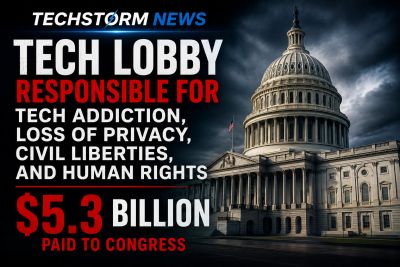
Threats Posed by The U.S. China Tech Lobby!
Due to the power of the U.S. China tech lobby, the Federal Trade Commission (FTC), Federal Communications Commission (FCC), Department of Justice (DOJ), and State Attorneys General are not enforcing numerous consumer protection, child protection, and FCC privacy laws aside from not enforcing constitutional privacy and property rights protections.
Enclosed below are just a few examples of many laws and constitutional protections that are not being enforced.
Constitutional Protections
Fourth Amendment — U.S. Constitution: Protects people against unreasonable searches and seizures by the government and establishes requirements for warrants, including probable cause and particularity regarding the place to be searched and the persons or things to be seized.
The Amendment specifically protects the right of people to be secure in their “persons, houses, papers, and effects.”
Fifth Amendment — U.S. Constitution: Protects individuals from being deprived of “life, liberty, or property, without due process of law” and prohibits the government from taking private property for public use without just compensation. It also protects against self-incrimination and double jeopardy and requires grand-jury indictment for certain serious federal crimes.
Fourteenth Amendment — U.S. Constitution: Protects individuals from being deprived of “life, liberty, or property, without due process of law” by a state and guarantees equal protection of the laws to all persons within a state’s jurisdiction.
Federal Trade Commission Act (FTC Act) — 15 U.S.C. § 45
Non-Enforcement of Existing State and Federal Laws
FCC Privacy Laws
Electronic Communications Privacy Act (ECPA) — 18 U.S.C. §§ 2510–2523, 2701–2713: Establishes federal protections against certain unauthorized interception, access, use, and disclosure of electronic communications and stored electronic communications, including communications such as telephone calls, emails, and other electronic data, subject to statutory exceptions and lawful government access procedures.
Cable Communications Policy Act (Subscriber Privacy) — 47 U.S.C. § 551: Protects cable subscribers’ personally identifiable information by restricting its collection, use, and disclosure by cable operators, requiring notice of their information practices, and generally requiring subscriber consent before personally identifiable information may be disclosed, subject to statutory exceptions.
Customer Proprietary Network Information (CPNI) — 47 U.S.C. § 222: Protects the confidentiality of customers’ proprietary telecommunications information by requiring telecommunications carriers to safeguard CPNI and restricting its use and disclosure without customer approval, subject to specific statutory exceptions.
FCC CPNI Regulations — 47 C.F.R. §§ 64.2001–64.2011: Establish rules requiring telecommunications carriers to protect the confidentiality and security of Customer Proprietary Network Information (CPNI) and govern how carriers may use, disclose, and provide access to customer information, including requirements for customer approval, authentication, safeguards, and compliance.
Communications Act – Just and Reasonable Practices — 47 U.S.C. § 201(b): Requires that all charges, practices, classifications, and regulations of common carriers for interstate or foreign communications services be just and reasonable and declares any unjust or unreasonable charge, practice, classification, or regulation unlawful.
Communications Act – Non-Discrimination — 47 U.S.C. § 202(a): Prohibits common carriers from engaging in unjust or unreasonable discrimination in charges, practices, classifications, regulations, facilities, or services, and prohibits giving any person, class of persons, or locality an undue or unreasonable preference or advantage or subjecting them to an undue or unreasonable prejudice or disadvantage.
Contracts of adhesion (terms of service) are illegal due to the fact they discriminate against individuals who turn down the contacts resulting in them being barred from using their telephone, computer, or product to access telecom and internet infrastructure regulated by the FCC.
Legal or consumer contracts cannot circumvent this FCC privacy law.
Communications Act – Public Interest Standard — 47 U.S.C. §§ 214, 309: Requires the FCC to consider the public interest, convenience, and necessity when authorizing certain communications services and facilities and when granting or renewing spectrum licenses, helping ensure that regulated communications activities serve the public interest.
Consumer and Child Protection Laws
Children’s Online Privacy Protection Act (COPPA) — 15 U.S.C. §§ 6501–6506; COPPA Rule — 16 C.F.R. Part 312: Protects the online privacy of children under age 13 by regulating how covered websites and online services collect, use, and disclose children’s personal information, including requirements for privacy notices, verifiable parental consent, data security, parental access and control, and limits on data retention.
It is currently illegal for any child under the age of 13 to use any phone, computer, or product supported by Android, iOS, or Windows due to the fact that these operating systems plus the AI infused apps and platforms are supported by uncontrollable surveillance and data mining technologies, addictive AI infused apps, plus predatory and exploitive surveillance and data mining business practices rooted in Surveillance Capitalism.
Children under the age of 13 receive specific federal privacy protections under COPPA, it is illegal for any child under 13 to accept a predatory contract of adhesion and terms of service.
It is incomprehensible that the tech industry successfully lobbied for policies that allow 13- to 17-year-olds to accept predatory contracts of adhesion and terms of service that can authorize extensive surveillance, data collection, targeted advertising, and exploitation of their personal information.
Video Voyeurism Prevention Act — 18 U.S.C. § 1801: Prohibits intentionally capturing an image of a person’s private area without consent under circumstances in which the person has a reasonable expectation of privacy, when the conduct occurs within federal jurisdiction.
Federal Trade Commission Act – Unfair or Deceptive Consumer Contracts — 15 U.S.C. § 45: Prohibits unfair or deceptive acts or practices in or affecting commerce, providing the FTC authority to challenge deceptive contract terms, material misrepresentations, hidden or misleading disclosures, and certain unfair practices that cause or are likely to cause substantial consumer injury.
Federal Trade Commission Act – Fraudulent Inducement and Deceptive Advertising — 15 U.S.C. § 45: Prohibits unfair or deceptive acts or practices in commerce, including materially false or misleading advertising, representations, or omissions that can induce consumers to purchase, subscribe to, or use products or services under deceptive circumstances.
Health Insurance Portability and Accountability Act (HIPAA) — 42 U.S.C. § 1320d et seq.; 45 C.F.R. Parts 160 and 164: Establishes federal protections for protected health information (PHI) held by covered entities and business associates, regulating how health information may be used and disclosed and requiring safeguards to protect its privacy and security.
FTC Health Breach Notification Rule — 16 C.F.R. Part 318: Requires covered vendors of personal health records and related entities that are not subject to HIPAA to notify individuals, the Federal Trade Commission (FTC), and, in certain cases, the media following a breach of unsecured identifiable health information, including certain unauthorized disclosures of health information.
Attorney-Client Privilege: Protects confidential communications between an attorney and client made for the purpose of seeking or providing legal advice, generally preventing those communications from being compelled or disclosed to third parties without the client’s consent, subject to recognized exceptions and waiver.
Stored Communications Act (SCA) — 18 U.S.C. §§ 2701–2713: Protects certain stored electronic communications and customer records from unauthorized access and disclosure and establishes legal procedures governing when electronic communications service providers may disclose stored communications and records to government entities and other parties.
Computer Fraud and Abuse Act (CFAA) — 18 U.S.C. § 1030: Prohibits certain forms of unauthorized access to protected computers and computer systems, including obtaining information without authorization, computer-related fraud, damaging protected computers, trafficking in passwords or access credentials, and certain other forms of unauthorized computer intrusion.
Non-Enforcement of National Security Laws
Protecting Americans from Foreign Adversary Controlled Applications Act (PAFACA) — Pub. L. 118-50 (2024): Addresses national security threats posed by foreign-adversary-controlled applications by prohibiting covered applications from being distributed, maintained, or updated through U.S. app stores and internet hosting services unless the application undergoes a qualified divestiture, subject to the requirements and procedures established by the Act.
It is currently illegal for Googel, Apple, and Microsoft to distribute highly addictive, intrusive, and exploitive apps, platforms, chatbots, AI products and services, retail apps, and other essential platforms developed in adversarial nations that include China and Russia.
Federal Information Processing Standards (FIPS): Establish federal cybersecurity and information-processing standards developed by the National Institute of Standards and Technology (NIST) for use by federal agencies and, where applicable, government contractors and other covered systems, including standards governing encryption, authentication, data security, and the protection of sensitive government information and information systems.
Classified National Security Information — Executive Order 13526; 18 U.S.C. §§ 793–798: Protects classified information relating to national defense and national security from unauthorized access, disclosure, transmission, or retention, with federal law establishing criminal penalties for certain unauthorized handling or disclosure of protected national security information.
Non-enforcement of Texas Consumer Protection, Child Protection, and Privacy Laws
Texas Deceptive Trade Practices–Consumer Protection Act (DTPA) — Texas Business & Commerce Code §§ 17.41–17.63
Texas Identity Theft Enforcement and Protection Act — Texas Business & Commerce Code Chapter 521
Texas Data Broker Law — Texas Business & Commerce Code Chapter 509
Texas Data Privacy and Security Act (TDPSA) — Texas Business & Commerce Code Chapter 541
Texas Privacy Protection Act — Various Texas statutory provisions
Texas Data Privacy and Security Act (TDPSA) — Bus. & Com. Code Ch. 541Collection, processing, sale and sharing of personal data; sensitive data; targeted advertising; profiling Texas AG; civil penalties
Capture or Use of Biometric Identifier Act (CUBI) — §503.001Fingerprints, voiceprints, iris/retina scans, face/hand geometry Texas AG; up to $25,000 per violation
Texas Data Broker Act — now Ch. 510Registration and security requirements for qualifying data brokers State enforcement
Texas SCOPE Act — Ch. 509Children's use of digital services, parental controls, collection/use of minors' data and algorithms Texas AG
Direct-to-Consumer Genetic Testing Law — Ch. 503ADNA/genetic data, consent, disclosure and consumer rights State enforcement
Texas Identity Theft Enforcement and Protection Act Sensitive personal information, identity theft and security breaches Texas AG
Texas Medical Records Privacy Act — Health & Safety Code Ch. 181Medical/health information; Texas protections that operate alongside HIPAA State enforcement
State Consumer Protection Laws — Varies by State
Electronic Bill of Rights (EBOR) - Digital Rights Framework
The Electronic Bill of Rights (EBOR) is a nonpartisan digital rights framework that aligns technology innovation with consumer protection, privacy, security, and public trust.
Tech addiction, harm, loss of privacy, security, safety, civil liberties, and human rights affect everyone, aside from teens and children.
Tech addiction, addictive design, harm, and exploitation are not just associated with social media apps and platforms, addictive design is embedded into nearly AI infused app, platform, social media, chatbot, and essential platform today.
It does not make sense to single out social media alone, nor hold social media developers accountable only, advertisers are equally responsible for tech addiction and harm by funding the problem.
Google, Apple, and Microsoft are equally responsible for tech addiction and harm for distributing highly addictive AI infused apps, social media platforms, and chatbots globally through preinstalled app agreements, plus through Google Play, Apple App Store, and Windows App store.
The U.S. government is responsible as well for not enforcing existing consumer and child protection and privacy laws, or enforcing telecommunications and internet privacy laws due to the powerful tech lobby.
Protecting children today is not enough if they simply grow up to become adults who are addicted, exploited for profit, and deprived of their privacy, security, safety, civil liberties, and human rights through the phones, computers, and internet-connected products they depend on every day.
The goal should not be limited to protecting children—it should be to create a digital ecosystem where people of all ages can safely live, work, communicate, and innovate without being subjected to surveillance, behavioral manipulation, or exploitation through the products and services they purchase.
This is why we need EBOR to protect our Name, Image, Likeness, and Data from being exploited for profits at the expense of our privacy, security, safety, civil liberties, and human rights.
EBOR Mission Statement
EBOR’s digital rights framework differs from other policy frameworks because it was authored from an app and platform developer’s perspective rather than from the perspective of a technology or advertising lobbyist. It focuses on the root causes of tech addiction, harm, exploitation, and the loss of privacy, security, and safety, rather than addressing each issue separately.
EBOR is not opposed to AI, social media, advertising, operating systems, apps, or AI- and quantum-driven platforms. It advocates for their responsible development and deployment in a manner that protects privacy, security, safety, civil liberties, plus human and consumer rights.
EBOR advocates for the right to privacy, security, and safety associated with essential phones, computers, and internet-connected products powered by Android, iOS, and Windows that support AI, apps, platforms, chatbots, social media, and other essential digital products and services, while restoring data, financial, and biological sovereignty to the product owner and all who depend on the internet for daily life.
EBOR is intended for policymakers, regulators, technology companies, advertising agencies, educators, and industry leaders seeking a modern framework for responsible digital governance.
EBOR promotes policies that:
EBOR builds upon existing federal and state consumer protection, privacy, telecommunications, and child protection laws. It advocates stronger enforcement of existing legal authorities while identifying areas where digital rights should be modernized to address today's AI-driven digital economy.
EBOR encourages constructive collaboration among:
The objective is to develop digital business practices that support innovation while protecting consumers, strengthening national security, and restoring public confidence in the digital ecosystem.
Our Products. Our Data. Our Rights.

Restoring Privacy, Security, and Consumer Protection Under Existing Law**
Electronic Bill of Rights Framework for Clean Data Business Practices Are Available Upon Request.
Electronic Bill of Rights Framework for Clean Data Business Practices
Article I: Right to Data Privacy
Article II: Right to Data Security
Article III: Right to Digital Anonymity
Article IV: Right to Be Forgotten
Article V: Right to Opt-Out of Data Monetization
Article VIII: Right to Digital Freedom and Free Speech
Article IX: Right to Own and Control Digital Identity
Article X: Right to Decentralized and Open Internet
Article XI: Right to Protection from Corporate and Foreign Surveillance
Article XII: Right to National and Consumer Security and Safety
Article XIII: The Abolishment of Web Scraping, Web Crawling, and Web Tracking
Article XIV: The Right to Accountability from Tech Giants
Article XV: The Right to Safe, Secure, and Private Preinstalled Apps & Technology
Article XVI: The Right to Safe Technology
Article XVII: The Right to Influencer and Bot Transparency
Article XIX: Freedom from Addictive, Divisive, and Manipulative Technology
Article XX: Freedom from Government & Tech Collusion
Article XXI: Right to Data Collection Transparency
Article XXII: Freedom from Indiscriminate Surveillance and Data Mining
Article XXIII: Freedom from Forced Participation by Way of Legal Agreements
Article XXIX: Freedom to Control Technology and Connected Products
Article XXX: The Right to Transparent Legal Language & App Permissions
Article XXXI: Ban on Teen Acceptance of Legal Agreements
Article XXXII: Right to Transparent AI and Algorithmic Accountability
Article XXXIII: Right to Fair Terms, Conditions & Legal Consent
Article XXXIV: Anti-Trust Protections & Internet Centralization
Article XXXV: National, Internet, and Technology Safety
Article XXXVI: The Right to Sue and Hold Tech Giants Accountable
Article XXXVII: Prohibition on AdTech Surveillance Infrastructure in Government and Civil-Military Programs such as the U.S. Government and Palantir Technologies.
Article XXXVIII: Equal Protection for Digital Currency, Financial, Biological, Medical, Legal, and AI–Quantum Platforms
All rights, protections, and enforcement mechanisms established under the Electronic Bill of Rights shall apply equally to all essential digital services and emerging technologies, including but not limited to:
These protections shall extend across all layers of the digital ecosystem, ensuring that no platform, technology, or service is exempt from accountability due to its classification as “emerging,” “experimental,” or “innovative.”
Universal Applicability to AI-Infused Digital Services
The combined Articles of the Electronic Bill of Rights shall apply in full to all AI-infused applications, platforms, chatbots, and digital services, regardless of delivery model, including:
No developer, platform provider, or technology company shall bypass or dilute these protections through terms of service, contracts of adhesion, or technical architecture.
Future-Proofing Consumer Protection
As technology evolves, all new categories of essential digital services shall automatically fall under the protections of the Electronic Bill of Rights without requiring additional legislation.
This ensures that innovation does not outpace consumer protection, and that human rights, data sovereignty, and individual autonomy remain preserved in the age of AI and quantum computing.

Surveillance Capitalism- The Information Trafficking Industry Explained
Google, Apple, Microsoft, Meta, TikTok, Amazon, and other tech giants, including those from China and Russia are the largest data brokers in the world who develop operating systems, plus highly addictive and dangerous apps, AI, social media, chatbots, and other platforms to monitor, track, and data mine their paying customers for profits without compensating the customer who produces the product, their confidential personal and business information.
Most discussions about tech addiction, online exploitation, and the loss of privacy, civil liberties, and human rights associated with the use of highly addictive apps, AI, social media, and chatbots focus on individual symptoms rather than the system that creates them: the multi-trillion-dollar-per-year information trafficking industry known as Surveillance Capitalism.
Surveillance Capitalism is a business model centered on the control, manipulation, and exploitation of adults, teens, and children through phones, computers, connected products supported by operating systems, apps, AI, social media platforms, and AI chatbots that have become necessities of modern life, as much of today's global trade, commerce, communication, education, healthcare, banking, and entertainment is conducted through the internet.
Addictive, manipulative, and intrusive design has become essential for advertising agencies, plus operating system, app, AI, and platform developers.
Unbeknownst to most end users, many AI-infused apps supporting phones, computers, and connected products are designed not only to provide functionality, but also to enable developers to monitor, track, data mine, influence, and manipulate user behavior for profits generated through targeted advertising.
As a result, the owners of smartphones, computers, and connected products end up funding their own surveillance, data mining, consumer exploitation, and behavioral manipulation through the very products and services they pay for.
This extends beyond the individual user to include family members, coworkers, and children whose information may also be collected, analyzed, and monetized at the expense of their privacy, security, and safety.
This is morally wrong on many levels because the product owner not only pays for the product and service but also produces a valuable commodity—their personal and business information. That information is then collected, aggregated, shared, and monetized by manufacturers, developers, advertisers, data brokers, and third-party partners through predatory terms of service that form contracts of adhesion, forcing participation through coercion rather than through informed and meaningful consent.
While Surveillance Capitalism is primarily fueled by the targeted advertising industry, it extends far beyond advertising. It has evolved into a global system of behavioral influence, data extraction, and control delivered through everyday consumer and enterprise telecommunications and technology products. At the center of this ecosystem are phones, computers, and connected products supported by Android, iOS, and Windows—the dominant operating systems developed by Google, Apple, and Microsoft that serve as the primary gateways to the digital world.
Google, Apple, and Microsoft control access to global internet trade and commerce through the monopolization of the operating system market, plus control over the global development and distribution of AI, apps, social media platforms, digital currency and financial platforms, entertainment and mass media platforms, and AI Chatbots that are required to be developed to support Android, iOS, or Windows to be distributed globally through preinstalled app agreements and through Google Play, Apple App Store, or Microsoft App Store.
The Electronic Bill of Rights (EBOR) addresses the broader digital ecosystem responsible for the harms caused by Surveillance Capitalism, enabled by technology monopolies, protected through lobbying, and delivered through the phones, computers, and connected products billions of people depend upon every day.
The sections below provide a high-level overview of this system. For a detailed analysis, see the report: The Digital Control System: Understanding the Structure Behind Surveillance Capitalism.
The economic engine driving the modern internet is targeted advertising. At the center of this ecosystem are global advertising technologies, including Google's AdTech Core Platform and interconnected advertising networks operating worldwide. These systems collect, analyze, and monetize personal information to maximize engagement, behavioral influence, and advertising revenue.
Most consumers gain access to digital products and services only after accepting lengthy, non-negotiable terms of service. These contracts often create a system of forced participation where meaningful consent is replaced by dependency on essential technologies.
A small number of technology companies dominate operating systems, app distribution, AI development, digital advertising, cloud infrastructure, and online commerce. Through extensive lobbying and political influence, these companies shape legislation, regulation, and enforcement affecting the digital economy.
The growing convergence of governments, technology providers, telecommunications companies, and data-driven platforms raises concerns regarding surveillance, censorship, social control, political influence, and the erosion of civil liberties and human rights through digital systems.
Operating systems, applications, social media platforms, AI systems, and chatbots serve as the primary interfaces through which users interact with the digital world. These technologies increasingly shape behavior, perception, decision-making, and access to information.
The digital ecosystem is delivered through billions of consumer products, including smartphones, computers, wearables, vehicles, smart home devices, and other connected technologies supported by telecommunications and internet infrastructure.
Advertising revenue supports a significant portion of modern media, online content, social platforms, search engines, and digital services. This creates incentives that prioritize engagement, attention, and data collection over transparency, privacy, and user well-being.
The harms associated with tech addiction, surveillance, privacy loss, censorship, manipulation, and the erosion of civil liberties are not isolated problems. They are the predictable outcomes of a larger digital ecosystem built upon surveillance, data extraction, and behavioral influence.
The Electronic Bill of Rights addresses the system itself by restoring sovereignty over a person's Name, Image, Likeness, and Data (NILD) while extending privacy, security, safety, civil liberties, human rights, and digital rights into the AI and Quantum Digital Age.
This gives you a clean website section while allowing the full report to carry the detailed analysis and supporting evidence.
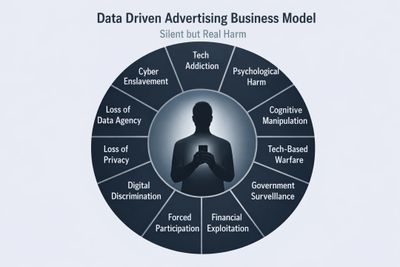
Executive Summary- Understanding Harms Caused by Targeted Advertising Rooted in Surveillance Capitalism
The Electronic Bill of Rights (EBOR) is not a theoretical framework—it is grounded in existing federal law.
Before individuals can understand how they are harmed, they must first understand how the surveillance capitalism business model operates through essential telecom and technology products—such as smartphones—that are necessary for modern life and come at a cost.
It is also critical to understand which devices and platforms—including those supported by Android, iOS, and Windows—serve as the primary vectors for surveillance, as well as the scale and scope of data extraction from those devices and services.
The following section explains how this process works, including:
It is not just privacy that is at stake—it is the systematic exploitation of individuals for profit at the expense of their privacy, security, and safety, as well as their data and financial sovereignty, biological autonomy (including biometric and genetic information), civil liberties, and fundamental human rights by way of products and services that cost money.
Modern connected devices—including smartphones, tablet PCs, connected home products, personal computers, servers, wearable technologies, security and environmental systems, connected vehicles, AI-enabled toys, and other digital services—form a pervasive and continuous data-collection environment.
These devices and platforms operate as always-on data collection nodes, enabled by operating systems such as Android, iOS, and Windows, as well as AI-infused applications, social media platforms, and chatbots.
Within this ecosystem:
This model is primarily supported by data-driven business practices centered on targeted advertising, often described as surveillance-based monetization.
Participation in this ecosystem is frequently governed by non-negotiable terms of service (contracts of adhesion), where access to essential products and services is conditioned on acceptance of broad data collection and use policies.
Data collected from individuals—including teens, children, and business professionals—is often facilitated through what can be described as “leaky operating systems” (Android, iOS, and Windows). These systems support a broad ecosystem of AI-infused applications, social media platforms, and AI chatbots that are designed to drive engagement and data collection at scale.
Within this framework, many of these applications and platforms function in ways that may be characterized as “legal malware”—software that operates within the bounds of the predatory contract of adhesion (terms of service) while enabling extensive data extraction, behavioral tracking, and monetization.
These operating systems and their associated ecosystems underpin essential connected telecom and technology products—including smartphones, computers, and other digital services—that are now required for participation in modern life.
The surveillance and data mining being conducted by Alphabet (Google), Apple, Microsoft, Meta, TikTok USDS JV, ByteDance (China), Wildberries (Russia), and others is "indiscriminate" meaning they are collecting from individuals, businesses, and government agencies is the following buckets of highly confidential information (over 5,000 data points):
All data collected from individuals—including teens and children—is aggregated into identifiable digital profiles, often referred to as Digital DNA. These profiles represent detailed behavioral, personal, and usage patterns tied to a specific individual.
Operating system providers and developers—including those behind Android, iOS, and Windows—enable the creation of these identifiable user profiles through system-level data access, application activity, and integrated services. These profiles are then leveraged for monetization, primarily through targeted advertising, as well as other commercial uses, including data sharing and resale.
In addition to data collected directly from device owners and end users, operating system providers, app developers, and AI platforms may also acquire and combine user profile data from third-party sources. This results in a layered aggregation model, where multiple entities contribute to and exploit increasingly comprehensive user profiles.
The outcome is a data ecosystem in which:
The widespread use of highly addictive and manipulative technologies embedded in AI-infused applications, social media platforms, and AI chatbots has contributed to a growing global technology addiction crisis. This crisis affects adults, teens, and children alike and has been associated with increases in anxiety, depression, violence, online bullying, self-harm, public discord, political polarization, and suicide.
At some point, the question needs to be asked:
"If addiction, harm, mental health decline, exploitation, and the loss of life among teens and children are not the line at which government, advertisers, and Big Tech change their business models, then what is?"
Individuals who access the internet through devices supported by Android, iOS, or Windows operating systems are subject to large-scale data collection and profiling within Google's global advertising ecosystems supported by the AdTech AI-Quantum Control Platform (Core) that distributes targeted ads to billions of people around the world 24x7/365 days per year.
Google's ecosystem—often described as the AdTech Core and ecosystem of micro cores—aggregate user data to enable the delivery of targeted advertising across international markets. Through a network comprised of over 35,000 data brokers, developers, advertisers, PR agencies, developers, and platform providers, user information can be distributed and utilized across multiple jurisdictions worldwide, including those in China and Russia.
This includes regions with varying regulatory standards, raising important questions about:
These platforms operate through interconnected advertising infrastructures—sometimes referred to as “micro AdTech ecosystems”—that support real-time bidding, audience targeting, and behavioral profiling at planetary scale.
Through biometric data, individuals can potentially be identified and located—even without carrying their personal device—using technologies such as facial recognition and voice pattern analysis. These capabilities can operate through nearby connected devices, cameras, or other networked products within close proximity via Google's AdTech Core and global ecosystem, for advertisers this is the greatest system every created, for military use it is the greatest targeting system on the planet.
Global advertising technology (AdTech) infrastructures—originally developed for commercial targeting—are increasingly being examined in the context of national security and information operations.
Large-scale AdTech platforms and their surrounding ecosystems enable capabilities such as:
These same capabilities may be leveraged beyond commercial use cases. Governments and state-aligned actors have been documented utilizing data-driven platforms and digital ecosystems for purposes including:
This convergence of commercial data infrastructure and government use cases is often described as civil–military fusion, where technologies developed in the private sector are adapted for national security and strategic operations.
Chinese and Russian civil military programs including those in the U.S. involving Palantir Technologies Gotham Intelligence and Military Core pose massive threats to privacy, security, and safety to everyone, including teens and children, connected to the internet by way of any device or services supported by Android, iOS, or Windows.
Summary of Harms Caused by Targeted Advertising Rooted in Surveillance Capitalism
Tech addiction cannot be compared to alcohol, drug, or tobacco addiction.
Addictive brain hijacking, manipulative advertising, and AI indoctrination combined equals military grade brainwashing technology far more dangerous than subliminal advertising technology banned in the 20th century.
Addictive design is equally harmful to adults as it is to teens and children and should be banned.
Engineered engagement loops create dependency, addiction, and loss of behavioral control.
Linked to anxiety, depression, loneliness, self-harm, suicide, online harassment, and social isolation.
AI and algorithmic systems influence perception, decision-making, behavior, and beliefs without meaningful awareness or consent.
Nation-states and adversaries exploit social media, AI systems, and consumer apps to conduct psychological and cognitive warfare at scale.
Government and platform alignment raises concerns regarding mass surveillance, civil liberties, and individual autonomy.
Phones, computers, and connected products have evolved into always-on surveillance and data-extraction systems.
Consumers must accept non-negotiable terms of service with no meaningful opt-out, negotiation, or informed consent.
Complex and fragmented terms of service obscure actual surveillance, data collection, and monetization practices.
Embedded tracking technologies enable multi-entity surveillance, hidden data sharing, and limited user visibility.
Consumers generate valuable data, pay for devices and connectivity, yet receive no compensation while platforms profit from their behavior.
Thousands of data points are used to create highly detailed profiles containing personal, business, biometric, health, behavioral, and location information.
Digital profiles can be used for pricing manipulation, opportunity restriction, bias, and unequal access to services.
Continuous monitoring across home, work, medical, legal, and social environments erodes fundamental rights at scale.
Control of digital ecosystems by a handful of technology companies concentrates economic power, market access, and control over personal data.
The current model persists because it is highly profitable.
This is not a failure of awareness—it is a failure of incentives and enforcement.
EBOR addresses the structural causes of these harms through:
Most policy proposals address only one layer of the problem.
EBOR addresses:
Because if the data is compromised, the intelligence built upon it is compromised.
The Electronic Bill of Rights calls upon lawmakers, regulators, businesses, critical infrastructure operators, tech safety advocates, privacy advocates, and consumers to recognize a simple reality:
Privacy, security, safety, civil liberties, human rights, and NILD sovereignty are not optional features—they are fundamental rights.
Together, these harms highlight the need for an Electronic Bill of Rights (EBOR) to restore privacy, security, safety, civil liberties, human rights, data ownership, and informed consent in the AI and Quantum Digital Age.
My name is Rex M. Lee and I am the author of the Electronic Bill of Rights, I have over 35 years of experience in telecommunications, cybersecurity, and technology, including serving as a senior executive.
As a result, when I write or speak about technology, telecommunications, and cybersecurity, I do so from firsthand experience.
I helped launch the world’s largest legal hacking firm, Houdinisoft, which was adopted by Verizon, Cricket (AT&T), MetroPCS (T-Mobile), and other global mobile network operators, as well as used for digital forensics.
I specialize in threats posed by Surveillance Capitalism, tech addiction, AI indoctrination, tech-based hybrid warfare, and civil-military fusion programs in Russia, China, and the United States.
In 2017, after advising Congress regarding the Facebook-Cambridge Analytica scandal, I was asked by Senator Ted Cruz’s office to author a congressional policy change proposal for digital rights from a developer’s perspective rather than from tech lobbyists working for Big Tech.
My initial digital rights proposal targeted the root cause of tech addiction, harm, and loss of privacy. It centered on banning Surveillance Capitalism, which would restore privacy, security, and safety to consumers of smartphones, computers, and connected products. Yet, my proposal was rejected by the U.S. Senate because there is no profit in solving the problem—especially by addressing targeted advertising, which fuels tech addiction and the loss of privacy.
I stopped advising Congress after the Instagram-Facebook whistleblower hearing involving Meta product designer Frances Haugen because the hearings became little more than puppet shows for grandstanding lawmakers who publicly claim they want to solve the problem while simultaneously taking money from the U.S.-China tech lobby. After each hearing, it became business as usual in Silicon Valley.
Aside from the harms caused by tech addiction, there are numerous other harms driven by targeted advertising rooted in Surveillance Capitalism (see harms below).
Addressing tech addiction alone will not restore privacy, security, or safety to consumers of smartphones, computers, and connected products powered by Android, iOS, or Windows.
Advertisers are equally—if not more—responsible for fueling tech addiction, manipulation, harm, and death among end users of AI-infused apps, social media platforms, and AI chatbots, including adults, teens, and children.
As a matter of fact, an entire multi-billion-dollar privacy industry has emerged in which so-called tech safety and privacy advocates make millions of dollars through books, documentaries, paid network TV and podcast appearances, interviews, and speaking fees.
While these efforts may raise awareness, many of these advocates refuse to fully endorse banning Surveillance Capitalism because this predatory, exploitative, and harmful business model fuels the very industry from which they profit.
Many of these so-called advocates, refuse to hold advertisers responsible for fueling the tech addiction, harm, and death, while refusing to hold Google, Apple, or Microsoft responsible for distributing highly addictive AI infused apps, social media platforms, gaming platforms, and AI chatbots that induce AI indoctrination, known as The Eliza Effect.
Without the continuation of Surveillance Capitalism, many of these paid advocates and attorneys would no longer have careers built around addressing the symptoms of a problem they refuse to eliminate at its root cause, Surveillance Capitalism.
Rex M. Lee: Rlee@ElectronicBillofRights.com